
books: Foreign
a memoir by anna carin hart
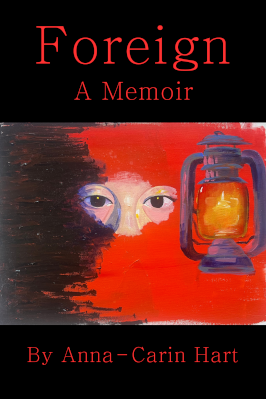
Anna lives her life on the periphery looking in. At least that’s her perception. There are occasions, sometimes even years, where she dips her toe, if not her whole being across the line to the inside. Some of her high school years feel like that, as does much of her time in Hong Kong. But even then, the niggling voice in her head is always there to remind her that she is “other” and does not belong. Anna is half Chinese, which is not quite Chinese enough. She is also half Swedish, even though as a young girl the split feels more 70/30 leaning towards Scandinavia. She is born in Seoul, then raised in various rented homes in the wealthy suburbs of Boston. As soon as she graduates from high school she runs away (from what she is not yet sure) towards an adventurous life that lands her at varies times over three decades in Los Angeles, London, Hong Kong, Singapore, and South Africa. In all these places, despite her best efforts, she never completely fits in, often being referred to as “The American Woman,” the irony of which is not lost on her. A part of her permanently feels foreign, even to herself, until one day, after years in exile in South Africa, she learns what it takes to belong.
Interested agents and publishers please contact: anna@mandarionom.com
Foreign - A Memoir
Foreign ~ Prologue
Cape Town, January 30, 2022, One day prior to Chinese New Year’s Eve
The Year of the Water Tiger
Am I Chinese? Somedays I think so. Other days, I have imposter syndrome, especially when I pop into Tong Lok at the Longbeach Mall near our home in Noordhoek for Asian groceries. I say Asian rather than Chinese because Mr. Li, despite being Chinese, supplies essential ingredients not only from China, but Japan, Korea and Thailand. My daughter often cooks with Korean sauces and spices, her favorite being Gochujang red pepper paste. There are few foods my middle son won’t add Japanese kewpie mayonnaise to. And, my youngest son likes Mr. Li’s wide selection of instant ramen noodles, especially the Buldak 2X Spicy Hot Chicken Flavor. I shop for all the basics for Chinese cooking in the small takeaway shop. I buy Lee Kum Kee’s hoisin and plum sauces, Kikkomen soy sauce, and White Rabbit candy, all the same brands I grew up with.
Around my 51st birthday my daughter tells me that I don’t look as Chinese as I used to. I smile at her and we laugh about it, but it feels like a punch in the gut, leaving a melancholy that will linger for months. I don’t blame her for saying it and she intends no harm. I think she means it curiously, like, “Hey Mom, isn’t it weird how you don’t look Chinese anymore?” To be fair, and herein lies the crux of it, I actually don’t look very Chinese anymore, the reason the words sting so much. How did that happen? Did I ever look it? I know I did because throughout my life, Asians from various countries would call me out. Like the time we were in Manilla in a tuk-tuk and the driver kept saying “China girl! China girl!” pointing to me, mystifying my new friends I was en route to Boracay Island in the Philippines with, one of whom I’d later marry, then later divorce. They didn’t know how the driver knew. We’d recently become friends and my ethnicity had never come up. Everyone assumed I was American because of my accent. I had somehow, and luckily I guess, managed to end up with a non-descript American accent, despite spending much of my formative years in Boston. Being “recognized” in Asia happened quite often, and for some reason, it was always by drivers; tuk-tuk, taxi, and even boat drivers like the one on the river in Bangkok and another one when we traveled along the Mekong in Vietnam. Shop keepers also seemed to know. Always the same wording, as if they’d conspired together and crafted the term just for me. Fingers would point at me as their smiles would widen before excitedly saying those words, China Girl! China Girl! As if they had discovered a secret and were expecting to claim a prize. But not Mr. Li.
I always greet Mr. Li with “Ni hao ma?” He returns the greeting by nodding his head in reply and saying “hello” in English back to me. I imagine that every time I leave his shop, he has a good laugh with his two staff, both young men from Zimbabwe, about the weird foreign lady trying to speak Mandarin. The way Mr. Li looks at me, I can see they’re all in on the joke. The way a patisserie owner in Paris might roll his eyes at an American tourist trying to order using a Lonely Planet French phrase book. Tong Lok is busy in the late afternoons, their takeaway business is extremely popular, although I’ve only ever purchased groceries there. I can hear my late father’s voice in my head warning me to stay clear of Chinese food from restaurants in strip malls. This advice would definitely apply here as the Longbeach Mall is in a remote beach town in South Africa, with an almost non-existent Chinese population. Many years later I will realize that Mr. Li’s take away is an exception to this rule, but I’m getting ahead of myself. Tong Lok gained popularity during the Covid pandemic, especially during the year of South Africa’s “hard lockdown” when the entire population was confined to their homes. Like most “Chinese” restaurants in South Africa, Tong Lok serves Chinese food, Japanese sushi and Thai curries. My teenagers and I are used it now, but when we first moved to Cape Town from Singapore in June of 2016, we found it extremely bizarre for these cuisines to be housed under one roof. You can get California Rolls, Thai Green Curry and top off your order with some Beef Chop Suey or Chicken Chow Mein. These latter dishes crack me up. All the Chinese dishes here are versions of American-Chinese cuisine. Given South Africa’s closer proximity to China, coupled with a sizeable number of Mainland immigrants (except in our beach town), wouldn’t it make sense for them to have been influenced by actual Chinese cuisine? I sometimes go to Tong Lok early in the day because it is very quiet then. I like to get a package of a dozen frozen bao around noon so it can thaw on my kitchen counter to be used for crispy fried chicken or char sui buns for dinner. I think the bao taste better if they are steamed when thawed, rather than frozen. I can feel my mother rolling her eyes at either of these options. Tut-tut. Bao should be made from scratch not purchased frozen. Her steamed bao, which has a slight sweetness I’ve never been able to replicate, is delicious. It’s funny how well she mastered many Chinese dishes, especially some complex specialties like Peking Duck, when one considers she is from Sweden.
Another reason I shop at Mr. Li’s early is to avoid having the bao be sold out. Bao dishes have become very popular around the globe in recent years and South Africa is no exception. If they are sold out, I will have to drive over the 11 kilometer mountain pass road, Ou Kaapse Weg, and from there another 15 minutes’ drive to Claremont to get to Mainland China Food Market, also run by a man named Li, no relation (he is from Taiwan). And there is a chance they’ll be sold out too.
I try to engage with Mr. Li this morning at Tong Luk. I know it’s crazy that I so desperately seek connection with the guy who runs the local takeaway? Why this recent need for validation? I know I am homesick for Asia, especially today given it’s the lunar new year holiday. I miss my friends. I miss the food. I miss the vibrant mix of cultures. I miss city life and skylines. But most of all, if I were to armchair psychoanalyze myself, I would say I miss feeling like I am part of something. Here, I live in a permanent state of being other. I told Mr. Li that I am Chinese when we first moved to Cape Town, but I could tell he didn’t believe me. He just nodded his head. I’m not sure I believe me anymore either. I suppose that is what happens after spending seven years in Cape Town being referred to as the American Woman.
Am I American? Legally, that’s a hard no. I don’t have an American passport. I relinquished my Resident Alien “green card” at the incredibly impressive, fortress-like imperial building that is the United States Embassy on Napier Road in Singapore after the “incident” in Boston. It was 2008. We were living in Singapore at the time. My children and I (I had two at the time) had recently visited family in Boston during which time I tried to secure a green card for my son. It did not go to plan. The day started at the JFK Building in Boston’s Government Center, and ended several hours later at the deportation office of Boston’s Logan Airport. My son was six-months old. The ICE officers, determining that neither myself nor my son should have green cards (unsettling as I had been in possession of mine for 37 years) said they were putting us on the next plane to Sweden, the country of my mother’s birth and the sole passport I carry. This would turn out to be the first of two times I am asked to “return” to Sweden. They were deporting us from America. They informed me that they would send for my daughter later and she would also board a plane to Sweden, but not the same one as us. This was incredibly alarming, even more so than the concept of deportation, as she was only eighteen months old at the time and being babysat by my sister-in-law at the home she shared with my brother 45 minutes’ drive from the airport. I was so confused about what constituted being American versus being foreign on that day. One of many strange stories and days that made me question that, but once again, I’m getting ahead of myself.
The people I grew up in a wealthy suburb 20 miles west of Boston, starting from first grade through to graduating from high school in May of 1989, would mostly assume I am American. Except my closest friends, many of whom I am still close to now. Others might know having followed my escapades with immigration and visa complications across three continents over the past twenty years on my social media. But the majority would have assumed I am American for the sole fact that I was there, in America, in the ultra-white suburbs of the late 1970s, going to school. It wasn’t something that ever came up. Nobody talked about ethnicity. Very few traveled overseas, although some had parents who went to Europe over the weeks they spent at summer camp in New Hampshire and Maine. If you were there, you must be American. Until the day she showed up, I certainly felt American.
At the international schools my children attended in Hong Kong and Singapore, everyone was from somewhere else, which was celebrated. Global Family Day was one of my favorite events at the international elementary school my children attended in Singapore. On this day, children would dress in costumes from their homelands and parade around the cement part of the school playground, grouped by country, making their way to two perfect sections, with an open walking space down the middle, where they would sit cross-legged on the hard surface with the tiny preschool students in the front row. Our last year at the school before moving to South Africa, 42 nationalities were represented. That is considerable considering it was a relatively small school. During the playground assembly, as the parents stood several bodies deep on the perimeter of the playground, a few songs would be sung, starting with the Singapore national anthem, always beautiful to hear from the voices of 400 children, then some songs about unity. One year it was “We Are the World,” which rang true given the diversity of students. Afterwards, the parents would enjoy food from around the world provided by the families. One year I made 100 Swedish meatballs. Another year I taught myself to make “Koeksisters,” a traditional South African dessert similar in taste and sugar content to donuts, but in a different, braided shape. My daughter got in an argument with one Laoshi (teacher), the head of the school’s Chinese department before the start of one year’s parade. She wanted to march in her red cheongsam under the Hong Kong flag, the country of her birth. She had done this her first year at the school without any issue. Since then, she had completed our family’s nationalities, parading one year with Hong Kong, another with Sweden, and finally, with South Africa. She was ready to do Hong Kong again. The previous year she’d marched under the South African flag with several other students from that country. Her brightly colored African Madiba shirt reaching well below her knees. The word Madiba means father in isiXhosa. The shirts were called this because Nelson Mandela, the greatly beloved father figure to South Africans wore them. Laoshi got upset with my daughter, scolding her using her Chinese name and told her she must march with China. “We are one country.” My daughter corrected her and said “But they are two places Laoshi. I am from Hong Kong.” She was fuming. She was 10 years old and as strong willed as any child I’d ever met, before or since, smart as a whip and wise beyond her years. I can’t remember what happened, I think my daughter refused to participate. Or maybe she walked with America that year. Like me, my children certainly have the accent. (It’s funny as at this point, I don’t think my youngest had ever been to America.) Also like me, the question of where we are from is a confusing one. Unlike me, thankfully, I don’t believe it has scarred them. Global Family Day and all the holidays we celebrated in Hong Kong and Singapore provided me the vehicles to instill a sense of pride in my children for all the places we come from. I wanted them to have connection to their heritage. I am glad I did that then. Once we moved to South Africa, the lines of our identity became harshly blurred.
Thankfully, Mr. Li has stock of bao buns so there is no need to schlep over the mountain. I have to make one more stop at Woolworths for the rest of the groceries needed for tomorrow’s Chinese New Year’s Eve banquet. This year it will be the four of us; myself and my three teenagers. Lately, as the teenagers have gotten older, we’ve enjoyed celebrating big holidays on our own, rather than inviting other families to join us. It’s more relaxing when it’s just us. (Thanksgiving being the one exception where we have 20 friends for dinner.) My elderly mother has texted from her home in Boston telling me how much money she is giving each of my children in their “lai see” Chinese New Year packets. Her generosity to them and her other grandchildren never in par with her means. I should be excited. I love this holiday and what it represents. It’s significantly more meaningful to me than the Gregorian New Year. And, my children still feel a sense of connection to Asia, although you’ll sense how that changes throughout the story. Yet I can’t shake a subtle sadness gently bubbling in my core. If we were in either Hong Kong or Singapore, where we’d lived a combined 20 years, there would be no escaping the energy and excitement of lunar new year. There would be events at school. Offices, malls and streets would be full of decorations and new year’s cheer. The grocery store would have an unbearable recording of young children singing a Chinese New Year song on permanent loop for months, but even that, as annoying as it is, is part of the holiday. There would be queues outside the banks as people lined up to get their crisp new dollars for their lai see packets. Children would be running around collecting those packets from every “Auntie” and “Uncle” they could find with the same verve they have trick-or-treating on Halloween. You would hear and say Kung Hei Fat Choi (Hong Kong) or Gong Xi Fa Cai (Singapore) to everyone you encountered for several weeks. And by everyone, I mean everyone. It was beyond festive. The icing on the cake would be the long holidays. Over our 20 years in Asia we had wonderful holidays with our friends over the lunar new year, from ski trips to Whistler in Canada, or Hakuba in Japan, to the beaches of Bali, the Philippines, Thailand and beyond. Having an “extra” week or 10-day holiday that our families and friends in other countries didn’t have felt special. But that was then. This, Cape Town, this is now. When the only Chinese person I know (on this side of Ou Kaapse Weg) doesn’t understand why I am wishing him Gong Xi Fa Cai.
Interested agents and publishers please contact: anna@mandarionom.com